Yes. A plywood supplier can provide multiple grades because plywood is classified by more than surface appearance. Face and back veneers may range from A to D under North American grading systems, while construction panels can also be specified by bond classification, species group, thickness, span rating, sanding, and intended use. APA standards classify veneer species into 5 strength groups, and PS 1-22 covers structural plywood requirements for veneer grading, adhesive bonds, construction, dimensions, tolerances, moisture content, marking, and quality assurance. A buyer should therefore specify the application and measurable requirements rather than order plywood using one grade name alone.
A supplier serving furniture, construction, concrete forming, flooring, packaging, and interior fitting will normally carry several specifications because the same surface quality does not suit every job. A furniture producer may pay more for a clean sanded face, while a crate manufacturer may accept patches and color variation if panel strength, thickness, and fastening performance remain suitable.
Under APA terminology, veneer grades run from A through D. A-grade veneer is smooth and suitable for applications where appearance or finishing matters, while progressively lower grades allow more natural characteristics and repairs. Panel names such as A-B or B-C identify the face and back veneer grades rather than providing a complete statement about moisture exposure or structural performance.
That distinction matters because two 18 mm panels with similar-looking faces may behave differently during routing, edge machining, drilling, lamination, or repeated wetting. Buyers purchasing 5,000 sheets for cabinet production often care more about thickness consistency, flatness, internal veneer quality, and surface calibration than about obtaining an unnecessarily high back veneer grade.
| Purchasing item | What should be specified | Why it matters |
|---|---|---|
| Face/back | A-B, B-C, BB/CC or agreed sample | Controls visible defects and repairs |
| Thickness | Nominal size plus tolerance | Affects machining and assembly |
| Inner veneers | Species and permitted gaps | Affects stability and fastening |
| Bond | Interior, Exposure 1 or Exterior requirement | Matches expected moisture conditions |
| Surface | Unsanded, sanded or overlaid | Affects finishing and lamination |
| Documentation | Standard, test report, declaration | Supports market and project requirements |
Thickness deserves separate attention because a nominal grade does not tell a furniture factory whether every panel will fit its machining program. A CNC line set for 18 mm stock can lose production time when panels vary enough to affect grooves, dowels, edge banding, or cabinet alignment, so commercial orders often state an agreed tolerance rather than relying only on the nominal number.
North American structural plywood specifications became more explicit about thickness identification in 2008, when panels began carrying both a Performance Category and decimal thickness designation. Modern procurement documents should likewise separate nominal product descriptions from measurable delivered dimensions, particularly when one shipment contains several thicknesses.
Internal construction is another reason suppliers offer different grades and price levels. Veneer species, ply count, lay-up, repairs, overlaps, gaps, and density affect machining and panel behavior even when the outer veneers look nearly identical. APA PS 1 classifies more than 70 wood species into 5 strength groups for structural plywood, with Group 1 representing the strongest group.
A buyer therefore needs to ask what is inside the panel. Hardwood, eucalyptus, poplar, birch, mixed-species, and other constructions can be selected according to weight, stiffness, screw holding, machining requirements, supply availability, and cost. For repeat orders of 10 containers or more, an approved cut-edge sample can help define acceptable internal construction more clearly than photographs alone.
Bond classification should also be written separately from veneer grade. APA identifies Exposure 1 plywood for applications where moisture may occur during construction but permanent weather exposure is not intended, while Exterior plywood is intended for repeated wetting and drying or long-term weather exposure. Bond classification describes adhesive durability; it does not by itself state panel strength or resistance to decay.
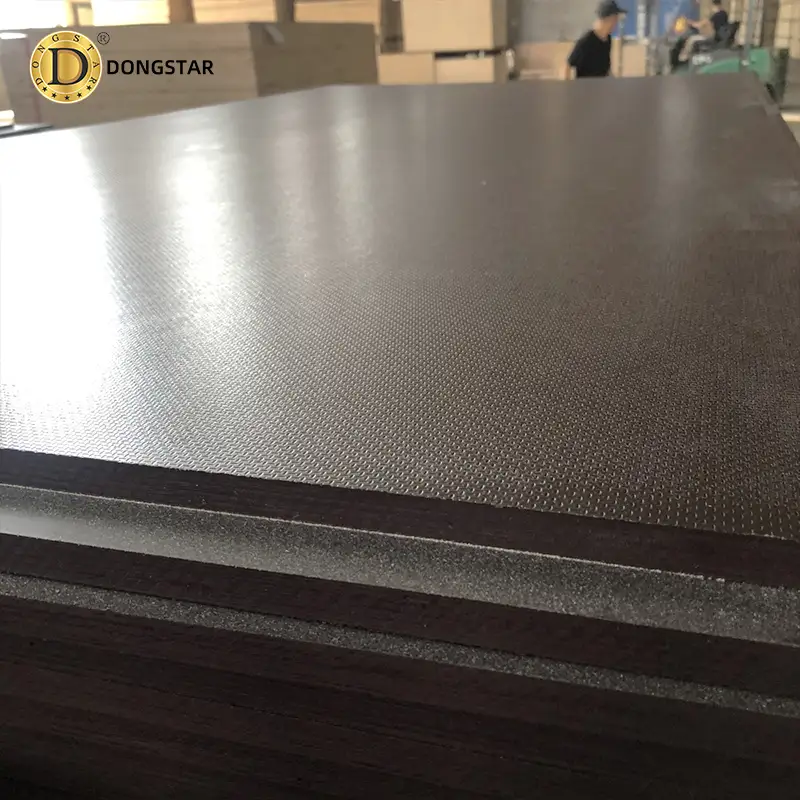
The distinction becomes important when purchasing Film Faced Plywood for concrete formwork. Surface film, panel construction, bond durability, thickness, edge sealing, support spacing, handling, concrete pressure, and release practices all affect service performance, so a buyer should not compare two formwork panels only by film color or sheet price.
APA reports that non-overlaid B-B and B-C Plyform panels commonly provide about 5–10 concrete-forming reuses, while HDO Plyform can support 20 to more than 200 reuses under appropriate conditions. Those figures are ranges rather than guarantees because cleaning, release agent, concrete mix, fastening, edge damage, storage, and job-site handling can materially change reuse life.
Marine plywood shows why the grade name must be tied to a published specification. Under APA information based on PS 1 requirements, marine plywood uses B-grade or better veneers throughout, carries an Exterior exposure durability classification, and permits internal gaps no larger than 1/8 inch. Standard availability includes several thicknesses from 1/4 to 3/4 inch.
Marine-grade material is also not automatically decay-treated. APA notes that chemical preservative treatment is a separate requirement when decay resistance is needed. A supplier quotation should therefore state the applicable standard, veneer requirements, bond requirement, thickness, treatment status, and supporting documents instead of using “marine” as a stand-alone commercial description.
Furniture plywood has a different purchasing profile. A manufacturer producing 20,000 cabinet parts per month may accept a lower back-face appearance when that side remains concealed, while requiring cleaner face veneer, calibrated thickness, low sanding variation, suitable emission performance, and consistent internal veneers for routing and edge finishing.
For laminated components, paying for two decorative faces may add cost without improving the finished item. A specification such as “selected face, utility back, calibrated panel, agreed inner-veneer construction” can match production needs more closely than requesting the highest visual grade on both surfaces.
Packaging plywood moves further toward functional grading. Crates, pallets, export boxes, and concealed industrial components usually tolerate more knots, patches, color variation, or repaired face defects. A purchasing team may instead set minimum thickness, panel dimensions, moisture condition, fastener performance, bond requirements, and allowable delamination criteria for a 2026 supply contract.
Construction orders require another set of controls because appearance grade cannot substitute for structural classification. PS 1-22, revised in 2023, addresses wood species, veneer grading, adhesive bonds, panel construction, workmanship, dimensions, tolerances, moisture content, testing, marking, certification, and quality assurance for structural plywood.
Span-rated panels add information that ordinary furniture grades do not provide. An APA 24/16 span rating, for example, relates to recommended support spacing for roof sheathing and subfloor use under specified installation conditions. A visual A or B face grade alone cannot provide the same structural design information.
European buyers also need to separate product quality from market compliance. Product specifications may include CE-related documentation where applicable, FSC chain-of-custody requirements where requested, formaldehyde-emission requirements, declarations, traceability records, and customer-specific labeling. The documentation package should match the exact mill, product, shipment, and claimed standard rather than being treated as general company paperwork.
EUDR timing is particularly relevant for wood-product supply planning. Following EU amendments made in December 2024 and December 2025, current European Commission information states that the regulation begins applying to large and medium operators on 30 December 2026, while most micro and small operators follow on 30 June 2027. Buyers should confirm the scope and obligations applying to their company and products.
Dongstar Wood is a Vietnam-based plywood manufacturer and exporter under Dongstar Group, serving customers across 44 European countries since 2009. We specialize in commercial plywood, film faced plywood, construction plywood, birch plywood, furniture plywood, and customized plywood solutions.
Backed by CE 2+, FSC®, EUDR, DOP, and SEDEX (BSCI) certifications, we meet European standards for quality, sustainability, and compliance. With over 15 years of manufacturing and export experience, we support importers, distributors, furniture manufacturers, and construction companies with reliable plywood supply and OEM/ODM solutions.
Customization becomes useful when standard catalogue grades do not match the customer's production line. A supplier may adjust dimensions, thickness, veneer species, face/back combination, sanding, overlays, adhesive system, packaging, branding, pallet configuration, or labeling, subject to production capability and minimum order quantities.
For example, commercial plywood may be ordered at 1220 × 2440 mm for one distributor and 1250 × 2500 mm for another. Dongstar Wood currently lists commercial plywood thicknesses from 3 mm to 40 mm and several veneer and inner-ply material options, illustrating how one supplier can sell multiple constructions under the broader plywood category.
Price comparisons become more useful once specifications are normalized. A USD 9 sheet and a USD 12 sheet are not directly comparable when one uses a lower face grade, wider thickness tolerance, different adhesive system, more internal repairs, or less demanding packaging. Multiplying a USD 3 difference by 20,000 sheets produces USD 60,000, but rejection and machining costs can also change the landed cost.
Sampling can reduce that uncertainty before production. Buyers can request full-size sheets or production samples and inspect thickness at several points, dimensions, diagonals, flatness, face repairs, edge condition, sanding, bonding, and cut sections. A 10-sheet review will not statistically describe an entire shipment, but it can expose obvious specification mismatches before a much larger order is released.
Inspection criteria should then move into the purchase order. Instead of writing “good quality plywood,” the order can state nominal dimensions, agreed thickness tolerance, face and back appearance, veneer species, internal construction, bond class, surface condition, moisture requirement, permitted repairs, packaging method, marking, documentation, and sampling method.
Batch consistency matters as much as the first sample. A distributor ordering 12 containers during 2026 may need each shipment to remain close to the approved specification because customers expect the same machining, appearance, packaging, and product identification from one delivery to the next.
Supplier evaluation can therefore focus on measurable capability: which grades are produced regularly, which are made to order, how incoming veneer is sorted, how bonding is controlled, how thickness is checked, how panels are sampled, which tests are completed internally or externally, and how production lots are identified.
For a new supplier, a practical order file can contain 8 items: signed specification sheet, approved sample, product photos, tolerance table, packing requirement, required documents, inspection method, and procedure for non-conforming material. That gives both parties a reference when appearance or production quality differs from the agreed purchase terms.
A plywood grade should finally be treated as one part of the specification rather than the whole specification. Face grade, back grade, internal veneers, adhesive performance, dimensions, moisture condition, surface treatment, applicable standard, documentation, packaging, and intended use can all be defined separately, allowing the supplier to quote the panel that matches the actual manufacturing or construction requirement.