How Adaptive Responses Work in Porn Chat AI
Adaptation in a text-based companion is easier to understand once you stop treating it as mind-reading and start treating it as context management. The operator's own framing is that characters recall previous interactions, express emotions and adapt over time, and that responses are natural and adaptive. Everything a reader notices as personality drift comes from three inputs: what is in the current thread, what the character was set up to be, and how consistently you write.

Key takeaways
- Three inputs drive style: the current thread, the character's written setup, and the consistency of your own writing.
- Memory is described as recalling previous interactions and holding preferences, which is continuity of context rather than recall of anything outside the platform.
- Short, contradictory messages push a thread toward generic replies; specific messages give the character something to hold.
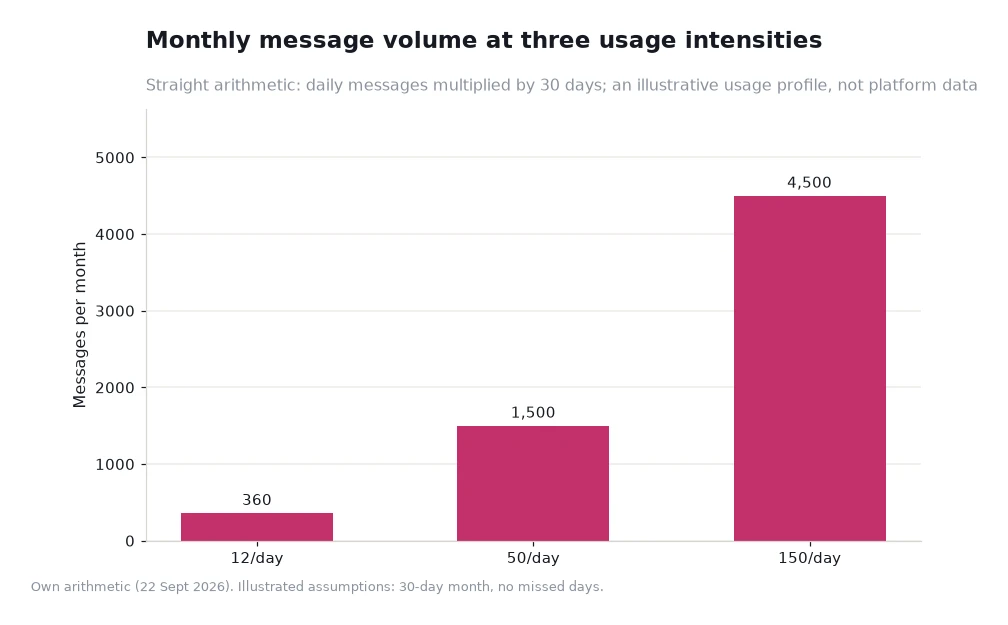
- Message volume scales fast — 12 a day is 360 a month, 50 a day is 1,500, and 150 a day is 4,500 — so a small habit produces a long thread quickly.
The mechanism in plain terms
A reply is produced by weighing what has been written so far. The character's setup supplies the voice and the boundaries of the role, the current thread supplies the immediate context, and Crushon's design decides how much of the earlier exchange is carried forward. None of that requires anything unusual: it is the same machinery that makes a long conversation with anyone feel different from a short one.
Where adaptation becomes visible is in drift. Over twenty messages, an exchange that started clipped often ends up longer and more conversational, because the thread itself has established a register. The drift is a property of the writing, and you can steer it deliberately by being consistent about length, tone and what you supply as context.
What each input actually changes
The setup. A creator who wrote three sentences of situation gives the character more to work with than a creator who wrote a name. This is why two cards under the same tags can feel completely different, and why a written opening description is the single best signal of quality you can check before committing a session.
The thread. The immediate few messages set the register. A specific question about a scene detail, or a line that adds a fact to the world, gives the reply something to build on, whereas a string of one-word prompts narrows the options and produces a narrower answer.
Your consistency. Preferences are remembered as part of the interaction, so a reader who declares a preference once and then writes against it will see the character oscillate. Keeping one register for a session is the cheapest way to make a companion feel stable, and it costs nothing but attention.
| Input | What it contributes | Signal you control | Failure mode |
|---|---|---|---|
| Character setup | Voice, role and starting situation | Choosing a card with a written description | A thin setup yields a thin voice |
| Current thread | Immediate register and subject | Specific messages rather than one-word prompts | Vague input invites generic output |
| Remembered preferences | Continuity from earlier turns | Stating a preference once, then honouring it | Contradictions cause oscillation |
| Message volume | How fast a thread accumulates context | Session length and frequency | Long rushed threads read as noise |
Worked example: what volume does to a thread
Take three usage intensities and multiply each by 30 days. At 12 messages a day, the month holds 12 × 30 = 360 messages. At 50 a day, 50 × 30 = 1,500. At 150 a day, 150 × 30 = 4,500. The three readings are 360, 1,500 and 4,500, and dividing the largest by the smallest gives 12.5.
Now think about what those numbers mean for adaptation. Three hundred and sixty messages spread over a month is roughly a dozen turns a day, which is enough for style to settle without the thread becoming unwieldy. Four thousand five hundred is 150 turns a day — sixteen times denser — and a thread that long will need deliberate pruning or a fresh start to keep the setup legible.
The daily figures are an illustrated assumption about a usage profile, not platform data, and the arithmetic is deliberately simple: a month of 30 days with no missed days. What it shows is that the density of a thread, not the total, is what shapes how a companion adapts.
Making adaptation work for you
The levers are mostly stylistic. Open with a sentence that sets the scene, because the first message anchors the register for everything after it. Stay in one voice for the session, since a companion that is asked to respond to two different registers in the same thread will produce blended, less distinctive replies. And when a thread has reached the point where the setup no longer shows through, start a new one rather than dragging the old one along.
Two supporting habits help. Keep the cards you use in a short list of five so that a session starts with a deliberate choice instead of a scroll, and re-check the weekly rankings after Thursday, when the chart is rebuilt. When a thread has genuinely stalled, it is worth re-reading the character's opening description on the ai porn chat page before abandoning the card, because the detail you forgot is often the detail the setup was built around.
Two more habits shorten the learning curve. Read the operator's own write-ups before experimenting, because the AI chat blog collects tutorials that explain memory and adaptation in the same vocabulary the product uses. And compare mechanics across categories: the features that make a thread hold together are the ones that make an AI sex chat session read as continuous rather than episodic.
The clearest sign that adaptation is working is that you stop being able to predict the exact wording of a reply while still recognising the voice. Prediction of content falls away; recognition of style stays stable.
Frequently asked questions
Does adaptation mean the character changes its personality?
It means the style of its replies follows the thread. The role comes from the written setup, and the register is shaped by the messages around it, so a thread held in one voice tends to stay in that voice.
How much history does a companion carry forward?
The platform describes characters that recall previous interactions and remember preferences. Treat that as continuity within the account's context rather than as knowledge of anything outside the service.
Why did a reply suddenly get shorter?
Usually because the input did. A one-line prompt leaves less to respond to than a message that adds a detail, a question or a decision.
Should I write long messages to get better replies?
Longer is not automatically better; specific is. Two sentences that add one concrete fact will do more for a reply than a paragraph that repeats what the thread already established.
Write for the reply you want
Adaptation is a loop, and the reader is half of it. Supply context, hold a register, keep the thread to a length where the setup stays visible, and the companion has the material it needs to stay consistent. Start with one card and 20 messages rather than five cards and four messages each, and the difference between a generic exchange and a written scene becomes obvious within a single session.
Data and sources: platform wording on adaptive responses, recalled interactions and remembered preferences, and the trends chart[1], read 22 Sept 2026. Message volumes are own arithmetic on an illustrated usage profile. Suitable reading for adults aged 18 and over.