Reading Difficulty Against Your Share Output
Difficulty is the network's dial; your share output is the dial you control. At the 21 September 2026 reading of 132.76 T, the arithmetic is blunt: 500 TH/s produces roughly 0.000224 BTC a day, and a 5 PH/s rack produces ten times that. Read both numbers together and a payout stops being a surprise.

Key takeaways
- Network hashrate of about 1,003 EH/s means one terahash per second controls 9.97 × 10⁻¹⁰ of the total, so a 5 TH/s machine earns about $0.19 a day gross before any fee.
- Difficulty is recalculated every 2,016 blocks; the 21 September 2026 estimate pointed to a 2.12% decrease, which lifts the daily output of existing hardware by roughly the same margin.
- PPS+ settles the block-reward component hourly at a listed 4% fee, while the transaction-fee component is distributed with PPLNS logic at a listed 2% fee — two different numbers on two different slices.
- Hashrate without uptime is a spreadsheet number: an hour of downtime on a 10 PH/s farm costs about $15.83 of expected income at current difficulty.
Why the numbers move
Bitcoin targets one block every ten minutes. Every 2,016 blocks — about two weeks — the protocol re-tunes difficulty so that target holds, whatever hardware joined or left in the meantime. That single rule is why your income is a ratio rather than a fixed wage: the network pays 3.125 BTC per block plus transaction fees, and 144 blocks a day divide that reward among everyone who is hashing.
The practical consequence is that difficulty rises when hashrate rises, and each unit of hashrate then earns proportionally less. Read the other way round, an adjustment downward hands existing machines a small raise. The estimate published on 21 September 2026 was a 2.12% decrease, which would take difficulty from 132.76 T to roughly 129.95 T — about 2.2% more BTC per terahash per day for the same electricity bill.
Difficulty is a ratio, not a price
Difficulty says nothing about the dollar value of a coin. It only fixes how much work buys how much of the block subsidy. A miner who tracks difficulty without tracking BTC/USD is watching half of the equation, which is why the same 500 TH/s rack produced very different monthly revenue across the past two years at constant hashrate.
What changes your payout
Four levers sit between the network's reward and your wallet. The first is your share of network hashrate, which is simply your terahashes divided by the network total. The second is your payment method: PPS+ pays a theoretical reward per valid share with a listed 4% fee on the block-reward component and a listed 2% fee on the transaction-fee component, while PPLNS merges both components and charges a listed 2% on the combined amount.[1]
The third is uptime, which is where most small operations lose more money than they lose to fees. A rig that is offline for six hours in a month does not produce a pro-rated statement; it simply produces nothing for six hours. The fourth is hardware efficiency, because power cost is charged on every hour the machine runs, including the hours it mines at reduced hashrate after a thermal event.
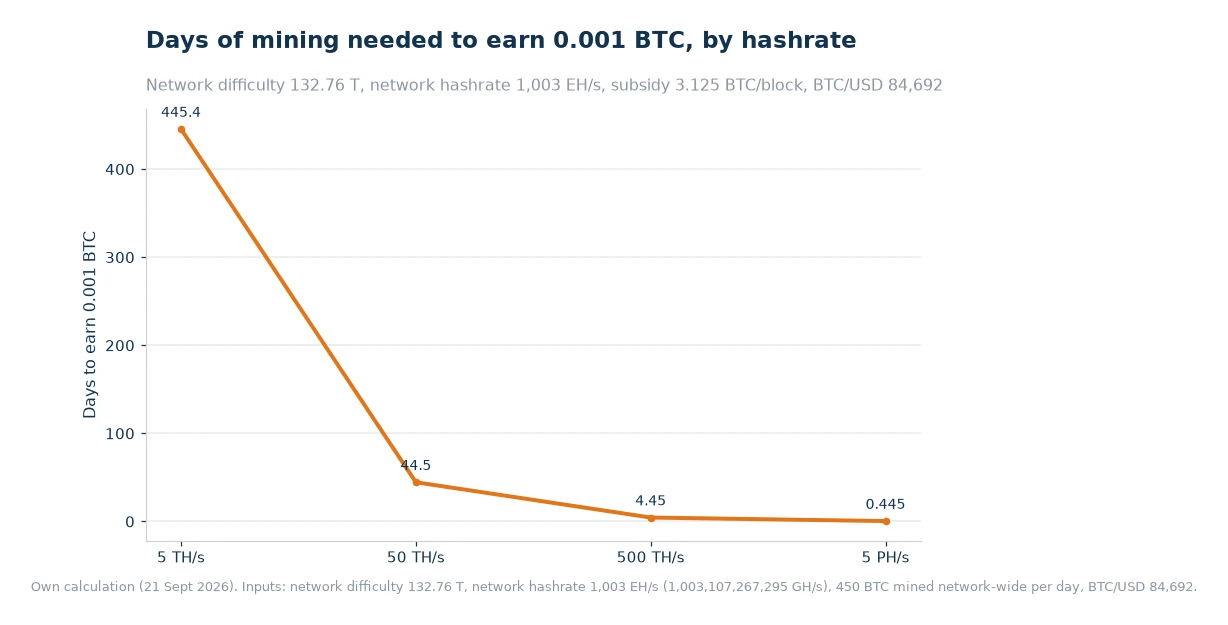
| Hashrate | Share of network | BTC per day | Gross USD per day | Net USD per day | Days to mine 0.001 BTC |
|---|---|---|---|---|---|
| 5 TH/s | 4.99 × 10⁻⁹ | 0.00000224 | $0.19 | $0.18 | 445 |
| 50 TH/s | 4.99 × 10⁻⁸ | 0.0000224 | $1.90 | $1.82 | 44.5 |
| 500 TH/s | 4.99 × 10⁻⁷ | 0.000224 | $19.00 | $18.24 | 4.45 |
| 5 PH/s | 4.99 × 10⁻⁶ | 0.00224 | $189.97 | $182.37 | 0.445 |
The table also explains why miners fixate on small percentages. A one-point difference in an effective fee is worth about 19 cents a day at 500 TH/s, or $5.70 a month. The same rack losing five hours of uptime in that month gives up roughly $3.17 of expected revenue — less dramatic, and far more common.
Worked example: 500 TH/s for a month
Take a single 500 TH/s ASIC running at 20 J/TH for 30 days. Daily output at current difficulty is 0.000224 BTC, or $19.00. Over 30 days that is 0.006729 BTC and $569.90 gross; after the listed 4% PPS+ fee on the block-reward component it lands near $547.
Power is the other half of the sentence. At 20 J/TH, 500 TH/s draws 10 kW, which is 240 kWh a day. At $0.06/kWh that is $14.40 a day, or $432 over the month, leaving roughly $115–138 of margin depending on which fee component the pool's 4% touched. Push electricity to $0.07/kWh and the power bill becomes $504, which narrows the margin to about $44 — a reminder that a miner's profitability is decided by J/TH and the power contract long before hashrate enters the calculation. Tools such as a miner profitability ranking exist precisely so this comparison can be made per machine model rather than per intuition.
Scale changes the shape of the problem rather than its nature. A 10 PH/s deployment at 20 J/TH draws 200 kW, or 4,800 kWh a day, which costs about $288 at $0.06/kWh against $379.93 of gross daily output. That looks comfortable until you notice that the same farm needs the full $379.93 to arrive; a pool whose ViaBTC BTC Mining Pool state page shows shrinking share, unstable latency or an opaque fee schedule turns a $92 spread into a cash-flow exercise.
What to check monthly
- Your realised average hashrate, not your nameplate hashrate. The difference is rejected shares, thermal throttling and short outages, and it is the number that actually earned money.
- Your effective fee, component by component. Ask what the percentage applies to: the block-reward slice, the transaction-fee slice, or the combined total.
- Your payout cadence against your invoices. Hourly settlement at 1 PH/s returns about 0.0000187 BTC, or $1.58, every hour; weekly settlement changes how much cash you must keep parked.
- Your break-even electricity price. Recalculate it whenever difficulty adjusts or the coin price moves more than a few percent, and use an income calculator rather than last month's note.
- The gap between solo and pooled arithmetic. At 100 TH/s, expected time to find a block alone is about 69,660 days, so pooling is a variance decision rather than a cost decision.
Frequently asked questions
How often should a miner check pool statistics?
Weekly is enough for cash flow, daily if you are reconciling worker uptime or chasing a hashrate fault.
Does the payout method change my average income?
It changes the variance and the fee, not the underlying expected value: your share of network hashrate still sets the ceiling.
What does a difficulty adjustment do to my daily output?
It moves your output inversely. The 21 September 2026 estimate of a 2.12% decrease would take difficulty from 132.76 T to roughly 129.95 T, which is about 2.2% more BTC per unit of hashrate per day at unchanged coin price.
Can I increase my share without buying hardware?
Partly. Restoring offline workers and eliminating rejected shares recovers output you are already paying power for, and stable firmware avoids throttling. Overclocking raises nameplate hashrate while raising power draw, so compare the change in J/TH, not the headline number.
Keep difficulty and your own output on one screen
Track two lines only: the network's difficulty and your realised hashrate. Everything else — fees, payment method, settlement cadence — is a modifier you can read off a fee schedule in a minute. Recalculate your break-even power price after every adjustment, and treat any month where realised hashrate trails nameplate by more than a few percent as a maintenance ticket rather than a market problem.
Data and sources: ViaBTC fee schedule[1], ViaBTC income calculator[2] and miner profitability ranking[3]. Network difficulty (132.76 T), network hashrate (1,003 EH/s), the 450 BTC mined network-wide per day and the BTC/USD price of 84,692 come from public chain data and market feeds read on 21 September 2026; all daily output, margin and days-to-target figures are our own calculation from those inputs. Difficulty, price and fees change, so re-run the arithmetic before acting on it. Illustrative figures only — no return is guaranteed.